
Pulley Injuries Demystified: A Physiotherapist’s Guide for Climbers
Written by Physiotherapist, Quinn Turner
The dreaded pulley injury is the bane of a rock climber’s existence. Climbers grip small holds, pull on cracks, and support a great deal of their weight on their fingers. With sport climbing growing in popularity, injuries unique to the finger and hand have increased as well. Over 20% of climbing injuries are flexor pulley strains—a structure very sensitive to damage.

Well, those numbers sound important—so what is a pulley?
Understanding Finger Injuries in Climbers
〰️
Understanding Finger Injuries in Climbers 〰️
Anatomy
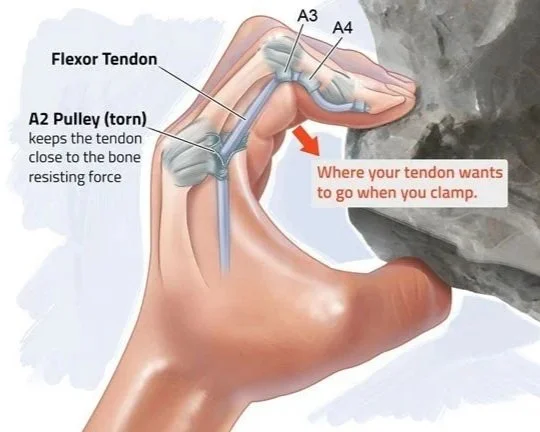
On the palm side of each finger are complex structures called pulleys, made of thick, fibrous, force-resistant material. Their main job is to keep the finger tendons pressed against the bone, allowing the fingers to grip effectively. Each finger—from pointer to pinky—has 8 pulleys, labeled A1–A5 and C1–C3. Different climbing grips place varying amounts of force on these pulleys. Unfortunately, the crimp grip—the most effective way to hold a small ledge—also puts the highest stress on them.
The Mechanics Behind Finger Injuries
All pulley injuries follow a similar pattern. The fingertip is violently extended while the middle joint stays bent—often happening when a climber falls while using a crimp grip. Forces at the fingertip can be magnified 3–4× at the pulley. For example, a 70 kg climber falling on a crimp grip can place up to 240 kg of force on this tiny structure! The finger still holding on—usually the ring finger—is most at risk. Common risk factors include novice climbers attempting hard routes, skipping warm-ups, and not allowing enough recovery time between workouts.
By encouraging relaxation and supporting the nervous system, acupuncture also helps reduce stress — a key factor that can influence hormonal health and fertility.
You were climbing, heard a pop, and now your finger hurts—what’s next? First, it’s important to assess the severity. Most pulley injuries can be managed conservatively by a rehab professional. Low-grade injuries typically take 6 weeks to 3 months for a full return to sport. Early management may include immobilizing the finger for a few days to weeks, followed by gentle range-of-motion exercises, tendon gliding, taping strategies, and progressive strengthening.
If the tendon “bowstrings”, it indicates a full pulley rupture. This injury usually requires surgery and carries an average 6-month return to sport timeline.

How do we prevent pulley injuries?
Take it slow and steady when you train. Pulleys, like all other parts of our body will respond to training and become stronger.
Additionally, a special tape job called an H-tape must be donned while climbing for months post-injury 1.
Have fun & play safe.
If a finger injury is holding you back on the wall, book an assessment with Quinn and get expert guidance to return to climbing safely.
References:
1. El-Sheikh, Y., Wong, I., Farrokhyar, F., & Thoma, A. (2006). Diagnosis of finger flexor
pulley injury in rock climbers: A systematic review. The Canadian journal of plastic surgery =
Journal canadien de chirurgie plastique, 14(4), 227–231.
https://doi.org/10.1177/229255030601400405
2. Shapiro, L. M., & Kamal, R. N. (2020). Evaluation and Treatment of Flexor Tendon and
Pulley Injuries in Athletes. Clinics in Sports Medicine, 39(2), 279–297.
3. Ginszt, M., Ginszt, A., Berger, M., Gawda, P., & Tarkowski, Z. (2016). Finger flexor pulley
injury of sport climbers – Literature review. Polish Annals of Medicine, 23(2), 191–194.
https://doi-org.login.ezproxy.library.ualberta.ca/10.1016/j.poamed.2016.01.009
4. Zafonte, B., Rendulic, D., & Szabo, R. M. (2014). Flexor Pulley System: Anatomy, Injury,
and Management. Journal of Hand Surgery, 39(12), 2525–2532. https://doi-
org.login.ezproxy.library.ualberta.ca/10.1016/j.jhsa.2014.06.005